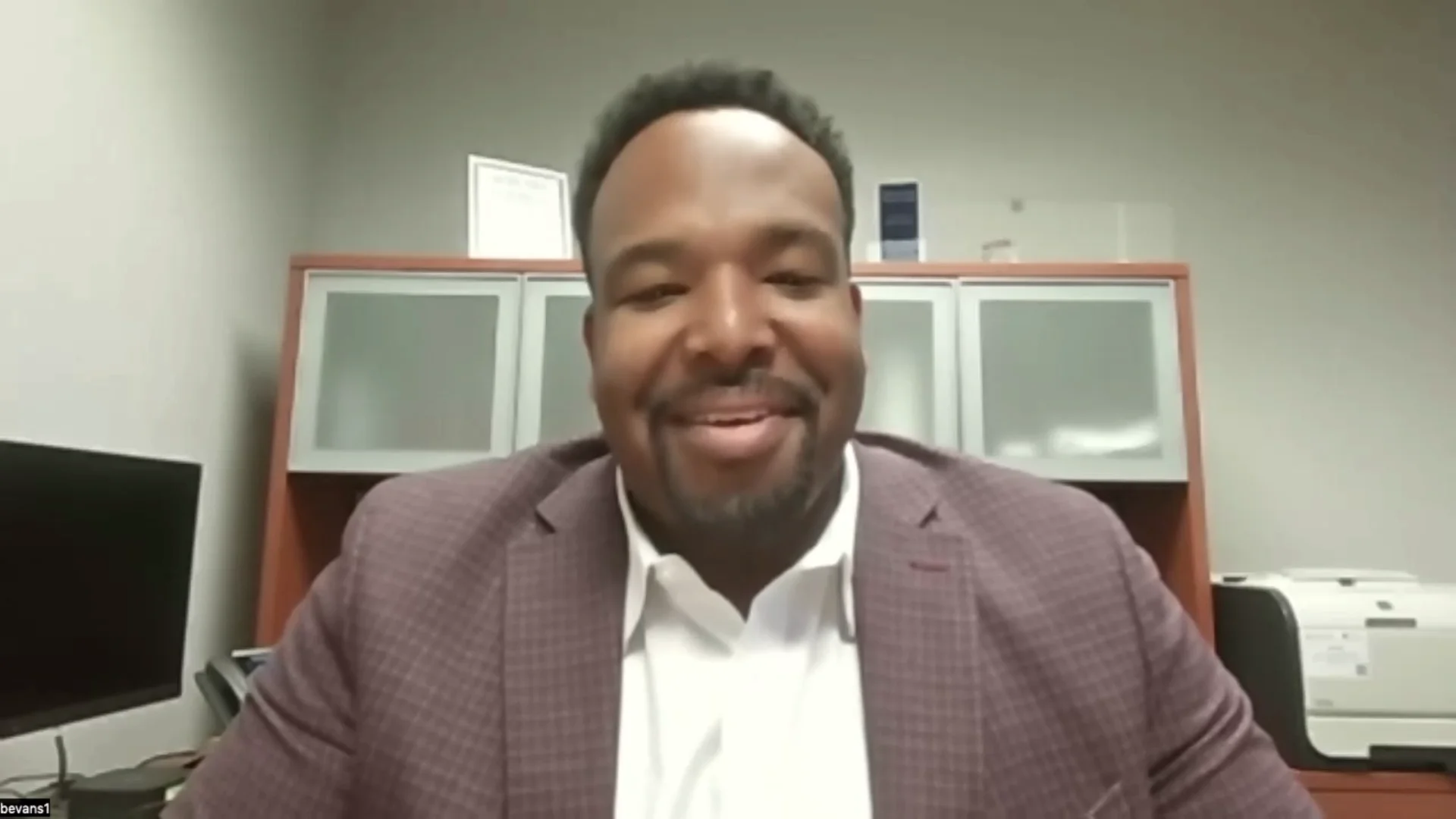
Guest: Blake Evans, System Vice President of Revenue Cycle, Rush University System for Health
Host: Praveen Chandran
Introduction and Frontline-to-System Revenue Cycle Leadership Journey
Praveen Chandran
You’re listening to The RC Executive Lounge podcast, the show where healthcare revenue leaders share real-world strategies, hard-earned lessons, and bold ideas shaping the future of revenue cycle.
Hi everyone, and welcome to the very first episode of Season 2 of The RC Executive Lounge podcast series. I’m your host, Praveen, and I’m really glad you’re all here for our Season 2 premiere. My heartfelt thanks to our audience for the incredible support in Season 1 and for continuing this journey with us into Season 2.
I’m extremely excited today to welcome a guest whose experience spans frontline patient access, consulting, and systemwide revenue cycle leadership in a major academic health system.
Our guest is Blake Evans, who serves as the System Vice President of Revenue Cycle at Rush University System for Health in Chicago, a multi-hospital academic health system with more than three billion dollars in annual operating revenue.
In his current role, Blake is responsible for the performance and transformation of the end-to-end revenue cycle, bringing together patient access, mid-cycle operations, and back-end functions under a unified strategy. He draws on more than fifteen years of revenue cycle leadership experience, including roles as Director of Patient Access at St. Vincent’s, Senior Manager in Healthcare Performance at Crowe Horwath, and Associate Vice President of Patient Access at Rush before stepping into his current systemwide position.
Blake’s path into this work is rooted in hands-on frontline experience. He started his career in patient registration and access in a community hospital setting, then moved into consulting and performance improvement, where he led large teams, implemented platforms such as Epic and Meditech, redesigned front-end revenue cycle processes, and helped organizations reverse financial declines through technology and process redesign.
That combination of operational depth and strategic perspective continues to shape how he approaches his role today. What I find particularly compelling is Blake’s leadership philosophy. In his first ninety days as System Vice President, he met with more than seventy leaders and stakeholders across Rush to listen first, understand the landscape, and co-create a shared vision for the future of revenue cycle, centered on digital transformation, process optimization, and a significantly better patient financial experience.
Blake has spoken openly about the importance of team alignment, transparent communication, and having the courage to make decisions with the best information available, even when the path isn’t perfectly clear.
Today, we’ll talk about his journey from frontline registration to system leadership, how he’s thinking about automation and a more touchless revenue cycle, the role of front-end access and patient experience in financial performance, and the leadership lessons he’s learned along the way.
Blake, welcome to the lounge. We’re very happy to have you here.
Blake Evans
Thank you. I’m very happy to be here. I really appreciate the opportunity.
Setting Strategic Priorities in Revenue Cycle Under Constant Pressure
Praveen Chandran
RCM teams have always operated under pressure, but today that pressure feels constant. Limited resources, payer delays, staffing gaps, and rising patient liability all converge at once.
How do you think about setting strategic priorities when you’re looking at the next twelve months versus the next three to five years?
Blake Evans
It’s a great question, and I can absolutely attest that there’s no shortage of pressure in the revenue cycle. That pressure is very real across almost every healthcare organization.
Margins are tighter, payments from insurance companies are increasingly delayed or reduced, and more responsibility is shifting to patients. Because of that, priorities can change not just daily, but sometimes hourly.
When I stepped into this role, one of the most important things we did was sit down as a leadership team and clearly define what we were going to focus on. We didn’t just react. We intentionally set strategic priorities for the year.
We landed on four core pillars. The first was becoming one Rush revenue cycle, bringing all teams under one structure, one set of processes, and one strategy. The second was optimizing revenue by strengthening our core blocking and tackling, collecting every appropriate dollar from insurers and helping patients with upfront payment options.
The third pillar was enhancing the patient financial experience. Patients can receive excellent clinical care, but a poor financial experience can overshadow everything. That has to be front and center.
The fourth pillar was scaling through automation. You can’t solve today’s pressures by adding endless headcount. Automation is the only way to scale the work sustainably.
Denial Prevention, Patient Financing, and Financial Assistance Strategy
Praveen Chandran
At every HFMA, MGMA, or RCM event, the same topics come up again and again: denial prevention, patient financing, and financial assistance.
How do these areas fit into your roadmap over the next year versus the next few years?
Blake Evans
They fit directly into that optimization pillar. Denial prevention starts with getting clean claims out the door quickly, but it doesn’t stop there.
Over the past year, we built a robust denials management program that includes cross-functional collaboration. Clinical teams, revenue cycle teams, and operational leaders are all at the table. Instead of pointing fingers, we focus on identifying trends together and fixing root causes.
That approach has paid off. We’ve seen reductions in initial denials in areas where we previously experienced spikes.
At the same time, patient liability is increasing. With policy changes and coverage shifts, patients are taking on more financial responsibility. That means we have to be proactive in educating patients early, clearly explaining liability, offering payment plans, extending those plans when appropriate, and communicating consistently throughout the patient journey.
We see our role as advocates, guiding patients from scheduling through registration, billing, and resolution, not just sending statements and hoping for the best.
Holistic Approach to Patient Financing and Financial Assistance
Praveen Chandran
When you zoom out, claims issues often flow downstream into patient financing and financial assistance. How do you think about that holistically?
Blake Evans
Every healthcare organization serves a mix of patient populations. Some patients are uninsured. Others are underinsured. Some can pay with support, and others truly cannot.
Our responsibility is to help determine the right path for each patient. That might mean setting up a payment plan, screening for Medicaid eligibility, offering zero-percent financing through a partner, or connecting patients to charity care.
We’re fortunate to be relatively generous in our financial assistance guidelines, but generosity also requires stewardship. We need to ensure assistance reaches those who need it most and doesn’t become a default coverage for ongoing care.
It’s really a mindset shift. This isn’t just about collecting money. It’s about advocating for patients and guiding them to the best financial option for their situation, whether that’s charity care, Medicaid, a payment plan, or referral to a community partner.
Making Tradeoffs and Saying No to Good Ideas
Praveen Chandran
Senior leaders are constantly forced to say no to good ideas because resources are limited. How do you approach those decisions?
Blake Evans
I think back to my early leadership days and a framework we used called a stoplight report: red, yellow, and green.
Green initiatives align with strategy and can move forward now. Yellow initiatives are good ideas, but not right now, so they go on the roadmap. Red initiatives aren’t aligned and won’t move forward, and we explain why.
This approach helps teams understand that “no” doesn’t always mean never. It might just mean not yet. It also creates transparency and avoids frustration when ideas aren’t immediately adopted.
Unifying the Revenue Cycle Through System Transformation
Praveen Chandran
Let’s talk about a major initiative your organization led. What challenge were you solving?
Blake Evans
One of our biggest initiatives was unifying the revenue cycle across the Rush system. Historically, we had multiple hospitals operating under different revenue cycle structures.
At the same time, we were consolidating multiple Epic service areas into one. That forced us to examine every revenue cycle process, evaluate best practices, and make difficult decisions about standardization.
It wasn’t easy. There was hesitancy and concern, as you’d expect when teams are brought together. But the work required collaboration, transparency, and tough calls. Even in the early days after go-live, results have been better than expected.
The goal is clear: one revenue cycle, one patient statement, consistent experience across the system, and the ability to scale automation and partnerships more effectively.
Implementation Challenges and Change Management
Praveen Chandran
Were there any surprises during implementation?
Blake Evans
Absolutely. Even with strong planning, anxiety surfaced around training, workflows, and decisions that had been made.
We addressed that by holding what we called a war room session. We brought leaders together, invited the next level down, and documented every concern. We ended up with more than a hundred items.
Those concerns became the foundation for FAQs, internal communication, and targeted fixes. The key was addressing issues head-on instead of letting them linger.
Measuring Impact and Revenue Cycle Performance
Praveen Chandran
How do you measure success for an initiative like this?
Blake Evans
In the short term, it’s about hitting milestones and timelines. The real test comes afterward, when you look at revenue cycle KPIs, patient satisfaction, and operational stability.
We track a wide range of metrics daily, from cash and AR to denials and bad debt. We’re also increasingly tracking automation metrics, understanding what AI tools are actually doing and how they’re performing.
Cash is still king, but the dashboard keeps evolving.
Agentic AI and the Path Toward a Touchless Revenue Cycle
Praveen Chandran
Agentic AI is everywhere in RCM conversations. What role do you see it playing over the next few years?
Blake Evans
It’s an exciting time. Revenue cycle is full of transactional work, which makes it a strong candidate for AI.
We were the first Epic client to go live with an AI billing chatbot that helps patients navigate bills, set up payment plans, request itemized statements, and apply for financial assistance, all without talking to a human.
That’s real value. But adoption has to be careful and risk-aware. We want to be early adopters while minimizing risk, especially when dealing with patient data and financial decisions.
Leadership, Communication, and Building Trust
Praveen Chandran
How do you build momentum for change at this scale?
Blake Evans
Communication is everything. You have to communicate early, often, and transparently, even when timelines change.
We use town halls, surveys, and regular updates to keep teams aligned. We also laid out a one-year roadmap and consistently speak back to it, showing where we are, what’s changed, and what’s next.
Trust is built through communication. When people understand the why and see follow-through, they stay engaged, even during difficult change.
Leadership Advice and Closing Reflections
Praveen Chandran
If you could give one piece of advice to another RCM leader or CFO, what would it be?
Blake Evans
Identify your pit crew. Leadership isn’t a solo sport.
Your pit crew might include team members, mentors, peers at other organizations, or leaders who can advocate for you. I meet monthly with neighboring hospitals and connect with peers nationally. We share challenges, vendors, and ideas.
Everyone needs that support system.
Praveen Chandran
Blake, this has been an outstanding conversation. Thank you so much for sharing your insights and for kicking off Season 2 with us.
Blake Evans
Thank you. I really appreciate being here.